
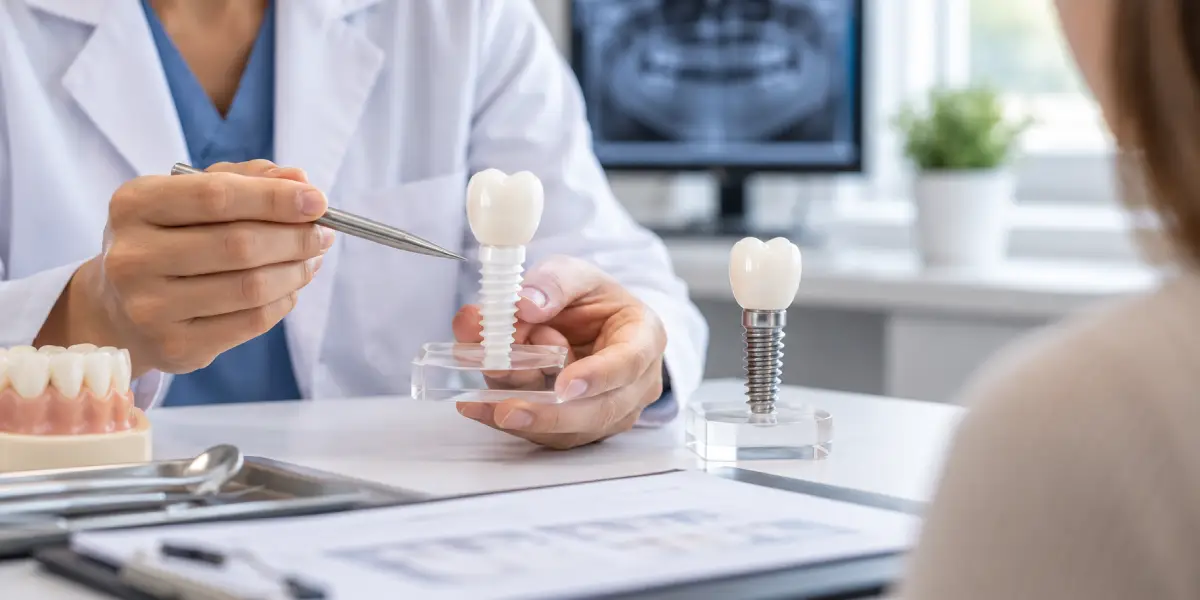
Choosing between ceramic and titanium dental implants depends on more than simply deciding whether you want a metal-free option. Ceramic vs titanium dental implants involve differences in material, appearance, implant design, clinical evidence, and restorative flexibility. Titanium has the longest and most extensive clinical track record, while zirconia ceramic implants offer a tooth-colored, metal-free alternative that can be appropriate for selected patients.
The best choice depends on your oral health, bone and gum conditions, implant location, esthetic goals, and treatment plan.
Understanding Ceramic and Titanium Dental Implants
A dental implant is a surgically placed device that replaces the root portion of a missing tooth. After placement, the implant can integrate with the surrounding jawbone through a process called osseointegration. A restoration, such as a crown, is then attached to replace the visible portion of the tooth.
Titanium has been used extensively in implant dentistry and remains one of the most established implant materials. Ceramic dental implants are generally made from zirconium oxide, commonly called zirconia. The FDA identifies titanium and zirconium oxide as the materials used in most dental implant systems and states that their safety profiles are well known.
The term "ceramic implant" can sometimes sound broad, but modern ceramic implants used for tooth replacement generally refer to zirconia systems. Zirconia is a ceramic material with a tooth-like color, while titanium has a gray metallic appearance. Both materials are capable of integrating with bone and supporting dental restorations.
How Do Ceramic and Titanium Implants Compare?
When comparing titanium vs ceramic dental implants, it is important to look beyond the material itself. Ceramic vs titanium implants can differ in material, appearance, implant design, clinical evidence, and restorative flexibility. Implant placement technique, the condition of the bone and gums, and the type of restoration can also affect treatment outcomes.
| Feature | Ceramic (Zirconia) Implants | Titanium Implants |
|---|---|---|
| Material | Zirconium oxide ceramic | Titanium or titanium alloy |
| Appearance | White or tooth-colored | Gray metallic |
| Metal-free option | Yes, depending on the complete implant system | No |
| Clinical history | Established but shorter than titanium | Extensive long-term clinical history |
| Bone integration | Can successfully integrate with bone | Well-established bone integration |
| Esthetic considerations | May be useful when a tooth-colored implant is preferred | Metallic color may be a consideration in certain esthetic situations |
| Implant designs | Available designs depend on the manufacturer and system | Broad range of established designs and components |
| Long-term evidence | Growing body of clinical evidence | More extensive long-term evidence |
| Two-piece systems | Available, but long-term evidence is more limited for some designs | Widely established |
| Patient considerations | May appeal to patients seeking a metal-free option | May appeal to patients prioritizing the longest-established evidence base |
Current research does not support the idea that one material is automatically superior for every patient. A 2026 systematic review and meta-analysis found that zirconia and titanium implants had broadly comparable clinical performance in the available comparative studies, while also noting that the evidence base remains limited and that more long-term research is needed.
Another 2024 systematic review found that titanium implants had a statistically higher survival rate and less marginal bone loss than zirconia implants at one year, although the authors noted that several other clinical outcomes did not show statistically significant differences. These findings demonstrate why implant material should be evaluated in the context of the individual case rather than reduced to a simple "better" or "worse" comparison.
What Are the Benefits of Ceramic Dental Implants?
Ceramic implants, typically made from zirconia, offer several potential benefits for patients who are considering a metal-free alternative to titanium:
- Metal-free option: Zirconia implants can be a good choice for patients who prefer to avoid metal in their dental treatment.
- Tooth-colored appearance: Unlike the gray color of titanium, zirconia is white or tooth-colored, which may offer an esthetic advantage in areas with thin gum tissue.
- Promising clinical results: Research shows that zirconia implants can achieve high survival rates. The International Team for Implantology reports a five-year mean survival rate of approximately 97.2% for the zirconia implants evaluated in its review, although this evidence primarily applies to one-piece systems.
- Growing evidence base: Research comparing zirconia and titanium continues to expand. A 2025 systematic review found no significant difference in biological complications between the two materials in the comparative studies evaluated, while noting that more long-term research is needed.
- Not automatically healthier: When considering ceramic implants vs titanium, neither material should be viewed as universally healthier. The right choice depends on your oral health, bone and gum condition, implant location, esthetic goals, and overall treatment needs.
What Are the Downsides of Ceramic Implants?
While zirconia implants can be a suitable option for some patients, they also have limitations to consider:
- Less long-term research: Zirconia has a shorter clinical history than titanium, so there is less long-term evidence available across different implant systems.
- Limited evidence for some designs: The ITI notes that five-year clinical data primarily applies to one-piece zirconia implants, while evidence for two-piece systems is more limited.
- Different implant designs perform differently: One-piece zirconia implants combine the implant and abutment, while two-piece systems use separate components. Their clinical and mechanical characteristics are not identical.
- Mechanical considerations: Different generations and designs of zirconia implants can have different mechanical properties, so results from one system should not automatically be applied to every zirconia implant.
- More research is needed: A 2024 systematic review found promising five-year outcomes for one-piece zirconia implants but emphasized the need for additional high-quality research on different zirconia designs.
- Not simply a "newer is better" choice: Zirconia should not be selected solely because it is newer or tooth-colored. The specific implant system, your oral health, anatomy, and treatment needs should all be considered.
What Are the Advantages of Titanium Dental Implants?
Titanium remains one of the most established materials for dental implants, with decades of clinical use and extensive research supporting its use.
- Long clinical history: Titanium implants have been studied and used successfully for decades, providing a substantial body of long-term clinical evidence.
- Extensive research: There is considerable research on titanium implant survival, complications, restorative outcomes, and long-term maintenance.
- Strong mechanical properties: Titanium provides the strength and durability needed to function as an artificial tooth root.
- Wide range of implant designs: Titanium is available in many implant sizes, shapes, and configurations, giving clinicians more options for different treatment situations.
- Restorative flexibility: Many titanium systems use separate implant and abutment components, allowing greater flexibility when positioning the implant and designing the final restoration.
- Established evidence base: When comparing ceramic implant vs titanium, titanium has the advantage of having a longer and more extensive clinical track record, although that does not mean it is automatically the right choice for every patient.
What Are the Disadvantages of Titanium Dental Implants?
Titanium is a well-established implant material, but there are still some factors patients may want to consider when comparing it with zirconia:
- Gray metallic appearance: Titanium is gray, which may be a consideration in highly visible areas, particularly when gum tissue is thin or has receded.
- Not metal-free: Patients who prefer to avoid metal may prefer to discuss zirconia implants as an alternative with their dental provider.
- Esthetic considerations: The appearance of the implant is only one factor in the final result. Gum thickness, implant position, tissue health, and restoration design can also affect esthetics.
- Titanium intolerance is rare: The ITI describes titanium intolerance as scarce, so concerns about titanium should not be interpreted to mean that titanium implants are generally unsafe.
- Patient-specific factors still matter: Choosing between titanium and zirconia should take into account your bone and gum health, implant location, restoration requirements, esthetic goals, and ability to maintain good oral hygiene.
Why Do Dental Implants Fail?
There is no single reason why every dental implant fails. Failure can happen early or later and may involve several biological, surgical, mechanical, or patient-related factors.
- Poor bone integration: Early failure can occur when the implant does not properly integrate with the surrounding jawbone.
- Insufficient initial stability: Inadequate stability when the implant is placed can affect successful healing and integration.
- Surgical factors: Surgical trauma or complications during implant placement can contribute to early failure.
- Infection: Infection around an implant can interfere with healing and contribute to implant failure.
- Smoking: Smoking is associated with reduced implant survival, greater crestal bone loss, and an increased risk of peri-implant disease.
- History of gum disease: Patients with a history of periodontitis have been found to have higher risks of implant failure and peri-implantitis compared with periodontally healthy patients.
- Peri-implantitis: Inflammation and infection around an implant can cause progressive bone loss and affect implant stability.
- Excessive forces: Excessive loading or mechanical stress can contribute to complications and implant failure.
- Bone quantity and quality: Insufficient or poor-quality bone can affect implant stability and successful integration.
- Long-term maintenance: Good oral hygiene and professional maintenance are important because dental implants can still develop inflammation and disease around the supporting tissues.
Because several factors can contribute to failure, there is no scientifically responsible single "number one reason" that applies to every dental implant case.
Are Dental Implants Becoming Less Popular?
There is no good evidence from the sources reviewed here that dental implants are becoming less relevant as a tooth-replacement option. The FDA continues to recognize dental implant systems as established medical devices, and the American Dental Association describes implants as a popular and effective way to replace missing teeth.
What is changing is the range of implant materials, designs, digital planning tools, and restorative options available to patients. Zirconia implants have expanded the choices for patients who prefer a metal-free alternative, while titanium continues to have a substantial clinical evidence base.
What Should You Know Before Getting Dental Implants?
Before getting dental implants, there are several important factors to understand:
- Treatment involves multiple stages: An implant is placed into the jawbone and must integrate with the surrounding bone before the final restoration, such as a crown, is attached. Healing can take several months depending on the treatment approach and your individual circumstances.
- Your overall health matters: Your dentist will evaluate your general and oral health before treatment. Gum disease, insufficient bone, certain medical conditions, and tobacco use can affect healing and implant outcomes.
- Age is not the only consideration: The American Dental Association notes that overall health can be more important than age when determining whether someone is a suitable candidate for dental implants.
- Implants require ongoing care: Dental implants still need daily brushing, flossing, and professional maintenance. They are not immune to oral disease, and inflammation or infection around an implant can lead to peri-implant disease and bone loss.
Is There an Age Limit for Dental Implants?
There is no universal age at which a person must stop receiving dental implants. The American Dental Association notes that general health can be more important than age when evaluating implant candidacy.
For an older adult, the evaluation may focus on overall health, bone condition, gum health, medications, healing ability, and whether the patient can maintain good oral hygiene. Being 70 or older does not automatically make someone ineligible.
At the same time, age should not be ignored completely. Older patients may have medical conditions or take medications that can influence surgical planning and healing. A thorough medical and dental evaluation is therefore more useful than relying on an age cutoff.
What Can You Eat With Dental Implants?
Dietary recommendations depend on where you are in the treatment process. Immediately after implant surgery, your dentist may recommend softer foods and avoiding pressure on the surgical site while healing takes place. The ADA explains that patients may be advised to eat soft foods, cold foods, and warm soup during the healing process.
Once the implant has successfully integrated and the final restoration has been placed, the purpose of the implant is to restore chewing function. However, your dentist may still provide specific instructions based on your restoration and individual circumstances.
Explore Your Dental Implant Options at Lynn Dental Care
If you are comparing ceramic vs titanium dental implants, Lynn Dental Care provides dental implant treatment in Dallas, TX, including ceramic dental implants made from zirconia. The practice explains that ceramic implants can restore the function and appearance of missing teeth and evaluates patients based on their individual oral health and treatment needs.
The right implant material is not simply a matter of choosing the newest or most attractive option. A comprehensive evaluation can help determine whether titanium or zirconia is appropriate based on your bone and gum health, implant location, esthetic goals, and restorative needs. Contact Lynn Dental Care to schedule a dental implant consultation and discuss which treatment option is right for you.
